Two mountaineers from the Basque Country contacted our institute when preparing for an expedition to the highest mountain of the Trans-Alai range in the Northern Pamir mountain region. Peak Lenin (7134m) borders Kirgizstan in the north and Tadzhikistan in the south. In 1928, the top of Peak Lenin was reached for the first time. Nowadays, it is a popular 7000-meter peak.
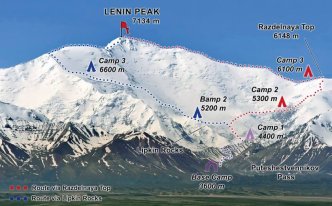 The twin brothers Aitzol and Axier Jaka (35), two passionate mountaineers, are aiming for the top of Peak Lenin the beginning of July via the Razdelnaya Top Route. It is their first attempt to climb a 7000-meter peak. They started preparing by evaluating personal previous high-altitude experiences. During a previous climb to Mount Elbrus (5610m), they observed individual problems with hypoxia. Although they stuck to common acclimatization procedure by climbing a 4000m peak beforehand, hypoxia caused difficulties during the summit attack day. In their opinion, the last sleeping altitude at 3750m was too low and caused a descent at an altitude of 5300m on summit attack day. They were able to reach the summit not before the following day.
„…instead, the next day, with really bad weather, windy and stormy, we could arrive the summit, because of the additional day of acclimatization.“ (Aitzol Jaka)
They draw following conclusions from this experience:
„our acclimatization process is slower than other people: we need more time to acclimatize than common people“
„we need ascend and sleep as high as possible to acclimate“ (Aitzol Jaka)
The evaluation of personal high-altitude experiences is the first important step when preparing further summit attempts, because acclimatization is a difficult process depending on many individual factors. There are no distinct scientific statements regarding acclimatization processes, which can be applied for every mountaineer. Scientific insights are mainly based on the collection of individual experience (F. Berghold, 2015, in Alpin- und Höhenmedizin).
Just as the two mountaineers assumed correctly, sleeping altitude is substantial for a successful summit ascent. The distances between sleeping altitudes define an acclimatization plan. For every single mountaineer, an individual “critical altitude” exists. After reaching critical altitude, several nights should be spent at this height, before further ascending. In order to avoid symptoms of acute mountain sickness (AMS), the daily sleeping heights above critical altitude should not differ for more than 400 meters. Since this is not applicable for many summit ascents (also the one of Aitzol and Axier) due to several reasons (including logistics), the number of nights spent at following altitudes defines a good acclimatization.
Principally, sleeping altitude should be as low as possible in order to provide optimal physiological regeneration. In return, the highest reached altitude per day can reach more than 1000 meters. The opportunity to descent to lower regions should always be given, especially after asking yourself questions like: do I suffer from headache or nausea after spending the night at altitude?
Aitzol reports from a further previous altitude experience:
„When I was in Ecuador, sleeping in refuges at 4700m – 5000m, I constantly woke up during nights. I couldn’t breath, it was a similar feeling to anxiety attack, but I wasn’t nervous and the next morning I was „well“ and I could climb without heavy headache…is it normal?“
With increasing altitude, subjective and objective sleep quality decrease in a linear matter. Studies show, that above 4000 meters, the prevalence of nightly arousals significantly increases. The partially unconscious arousals caused by a lack of oxygen saturation can last between a couple of seconds up to several minutes. The brain receives a signal of low oxygen saturation levels in the cells, which leads to accelerated heart rate and increased breathing rhythm (Pramsohler et al., 2019).
However, there are additional factors which influence sleep at altitude, such as position of upper body during sleep, cold inspiration air, digestion problems or pain. Daily activity also contributes to sleep quality. If an ascent on the previous day leads to severe exhaustion, increased adrenalin and cortisol levels can cause sleep loss, because they degenerate very slowly.
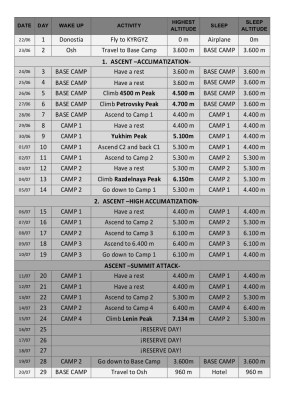 Based on their experiences, Aitzol and Axier developed an acclimatization plan for Peak Lenin (picture). For them, the critical part of the expedition will supposedly start at Camp 2 (5300m), because of a quite big altitude difference between Camp 2 (5300m) and Camp 3 (6100m).
Aitzol and Axier prepared the expedition with utmost care, they are well-trained and in good physical shape. Therefore, I’m confident, that the expedition will be a success. With a bit of luck, they will reach Peak Lenin summit between July 15th and 18th.
We will report on the ascent!


 HYPOXIA RESEARCH